
Do I need more VAT registrations before enabling Pan-European FBA?
Short answer
VAT obligations depend on where your business is established, how goods move and where stock is stored, not just which Amazon stores display your offers. Review actual inventory locations and enabled fulfilment settings before expansion. OSS and marketplace VAT collection do not automatically remove all registration or reporting duties; obtain country-specific tax advice.
Facts checked 3 min read
Also asked as
- Does OSS replace VAT registration where Amazon stores my goods?
- How do I check which EU countries hold my FBA stock?
- Is Remote Fulfilment the same as Pan-European FBA?
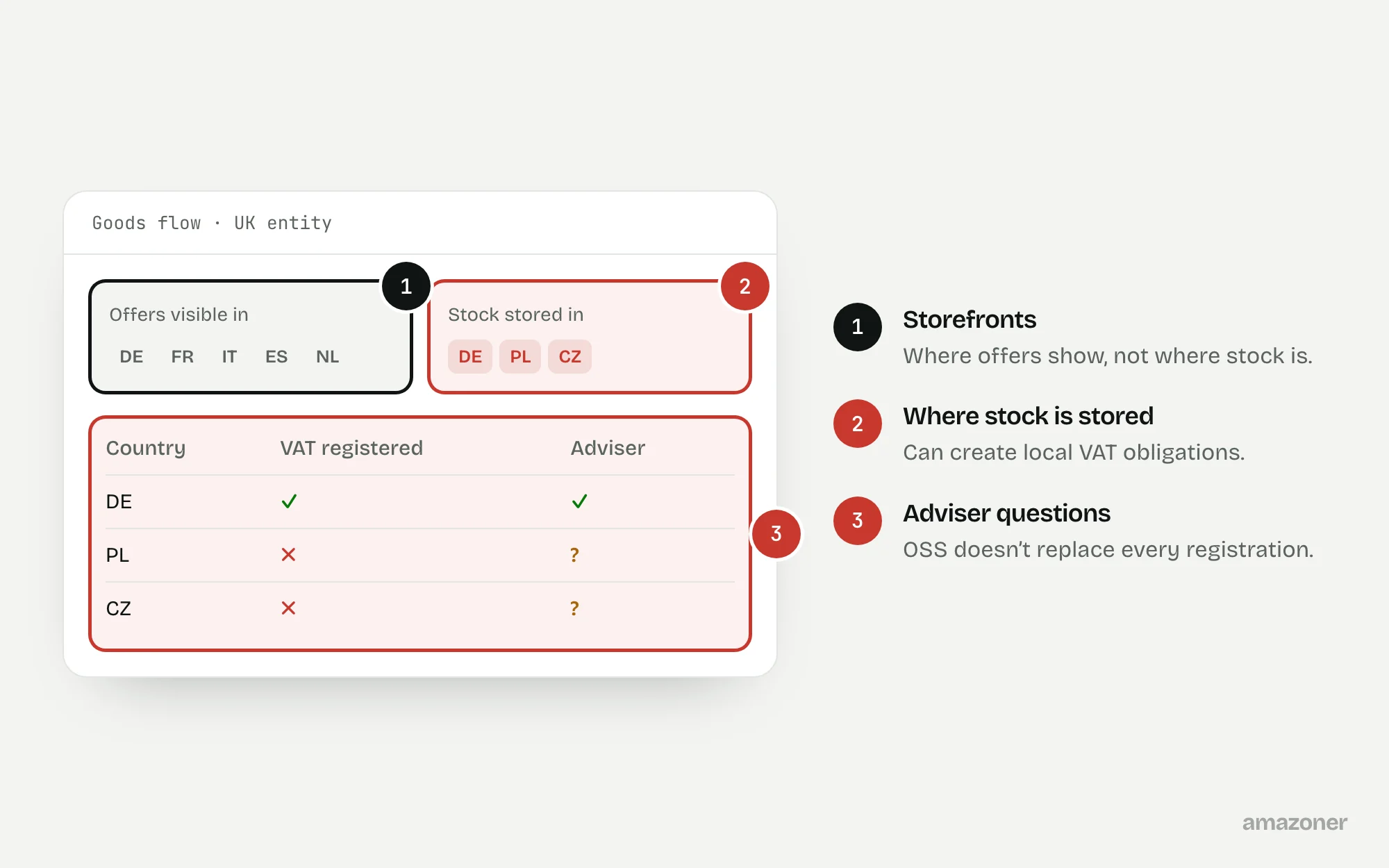
A typical case
A UK-based homewares brand
The brand wants local FBA fulfilment in more EU markets and assumes its existing registration and marketplace-collected VAT cover every stock movement. Offers show in several stores, but there’s no reconciled country-of-storage report, and returns, past programme settings and planned stock placement haven’t been reviewed with the accountant.
Don’t confuse these
- OSS
- The EU One Stop Shop scheme for reporting VAT on eligible cross-border sales in one return.
- Local VAT registration
- Registration in a specific country, which storing stock there can require.
- Marketplace VAT collection
- Amazon collecting VAT on certain sales as a deemed supplier, depending on the seller and the transaction.
Storefront availability, fulfilment origin, physical storage and VAT treatment are different things. Storing stock abroad can trigger local obligations, but programme arrangements and simplifications need a fact-specific assessment.
OSS covers eligible transactions within its scope; it isn’t a blanket substitute for domestic compliance, imports or every stock transfer. Great Britain and EU stock flows aren’t one customs territory. An audit identifies facts and gaps; it doesn’t give tax clearance.
Why it happens
Sellers often expand by switching on marketplace offers before documenting the logistics and tax model underneath. A linked European account or cross-border programme can look as though registration is handled automatically.
Actual stock placement, transfers and returns can drift from the intended country footprint, and an accounting summary of sales may leave stock movements out. The starting point is the movement of goods and the legal entity, not the list of active storefronts.
How to diagnose it
- 1
Document the entity
Record the selling entity, where it’s established, existing VAT registrations, import arrangements and intended markets, and ask the tax adviser to confirm obligations.
- 2
Review FBA settings
Record Pan-European FBA, permitted stock placement and any cross-border programme settings, without changing them.
- 3
Find where stock actually is
Use location reports such as the Multi-Country Inventory report and the Inventory Ledger, including past transfers and returns.
- 4
Check the tax settings
Reconcile VAT registration details in the account with the adviser’s records, and log any warnings and their dates.
- 5
Give the adviser the data
Provide the Amazon VAT Transactions Report and shipment and import records, with sales, returns and transfers mapped separately.
- 6
Build a launch matrix
For each country, show intended storage, verified movements, open questions and adviser sign-off, and hold new placement until resolved.
What we recommend
Reconcile actual and proposed stock locations, give the accountant complete movement and transaction evidence, and confirm the tax and customs treatment of the chosen programme before expanding.
Keep programme eligibility, VAT registration, return filing and fulfilment economics as separate workstreams. An audit can produce the readiness matrix and flag inconsistent assumptions; tax advice, registrations and filings need an authorised professional.
Common mistakes
- Assuming an offer in a store means stock is stored there, or that no stock now means no past obligation.
- Treating OSS, marketplace collection and local registration as interchangeable.
- Copying another seller’s Pan-European or call-off-stock arrangement without checking it fits.
- Enabling storage first and asking the accountant later.
Prevention checklist
- Get tax-adviser review before enabling a new storage country.
- Reconcile stock locations, movements and returns with the accounts.
- Keep a country matrix of registrations, filings and open questions.
- Keep VAT IDs, entities and importer details consistent.
- Review guidance whenever logistics or markets change.
What an audit gives you
Actual and proposed stock locations mapped by country, with a country-by-country checklist of questions for the tax adviser before expansion.
Related questions
Does OSS remove every local VAT registration?
No. It simplifies reporting for eligible transactions. Storage, domestic sales, imports and stock movements can raise separate questions.
Does selling on Amazon France mean my stock is in France?
No. The storefront and the fulfilment location are different. Check stock location reports and programme settings together.
Is Remote Fulfilment the same as Pan-European FBA?
No. They involve different stock placement and cross-border arrangements. Check the current terms and your actual goods flow.
Can Amazoner certify my EU tax compliance?
No. We prepare the facts for an audit; a qualified adviser must assess your obligations.
Sources
The seller questions and Amazon or regulator guidance this guide is based on, checked 7 November 2026.
- Pan-EU FBA. VAT (Amazon seller forums)
- UK seller - I have a warning to register for VAT in Italy (Amazon seller forums)
- VAT special schemes: OSS (European Commission)
- Enable local placement with a single VAT registration number (Amazon seller forums)
General guidance, not legal, tax or account-specific advice. Amazon’s rules, menus and programmes change; check the current version in your own account before acting.