
How can I remove the Frequently returned item badge on Amazon?
Short answer
You cannot assume that editing a listing will remove Amazon’s Frequently returned item badge. Review Voice of the Customer and return-reason reports, then address product, compatibility, packaging or expectation gaps. Amazon controls badge application and reassessment. A healthy NCX rating or improved seller-specific return figure does not by itself prove the badge is incorrect.
Facts checked 3 min read
Also asked as
- Why does my Amazon listing say frequently returned?
- Does a healthy NCX rating remove the returns badge?
- Can better compatibility information reduce Amazon returns?
A typical case
A consumer-electronics accessory brand
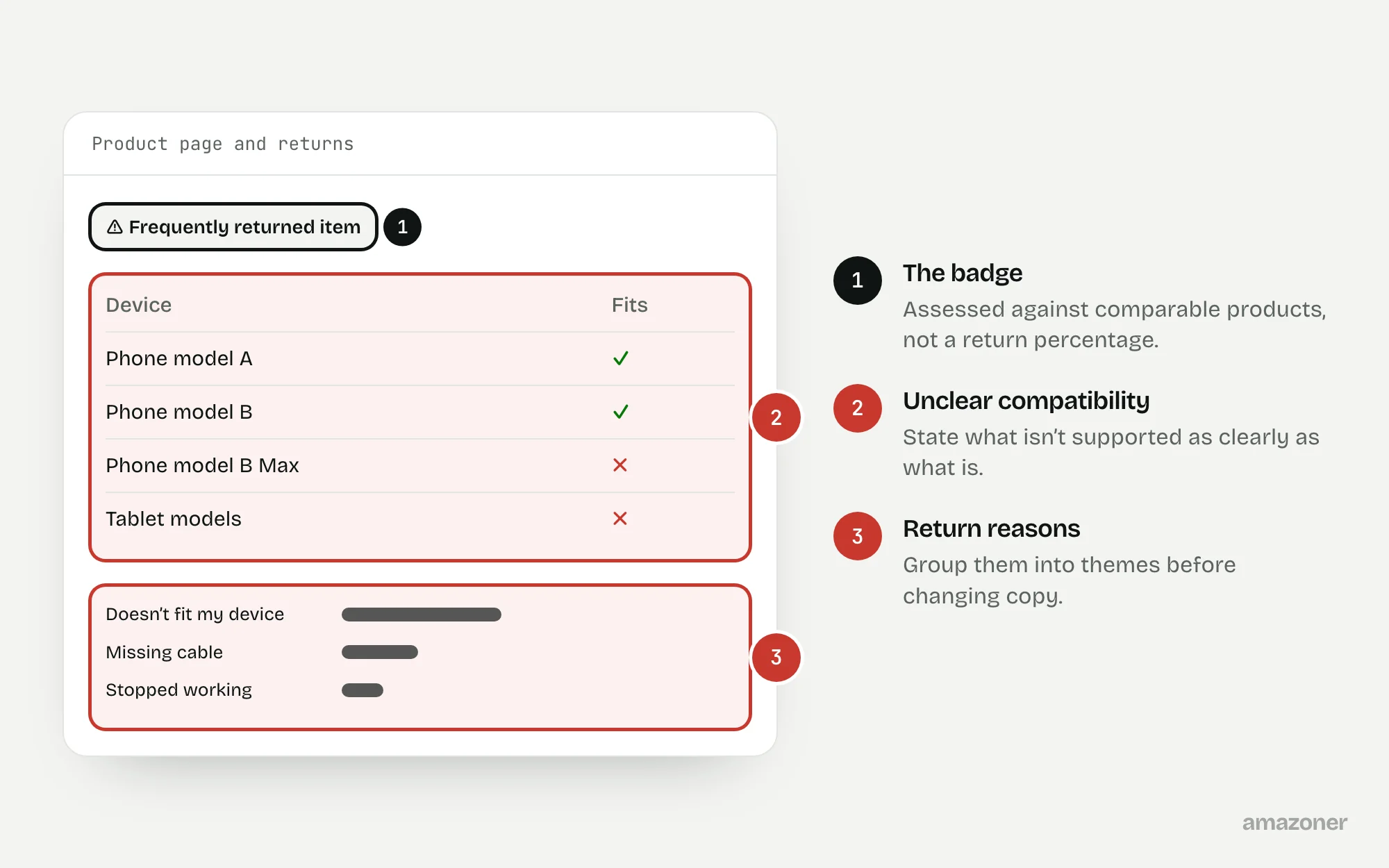
A returns badge appears despite a healthy-looking customer-experience view. The listing uses broad compatibility wording without saying which devices aren’t supported. Return reasons and product specifications need reconciling before anyone assumes the warning is an error, or that a copy change will remove it.
Don’t confuse these
- Frequently returned badge
- Amazon’s warning on the product page, assessed against comparable products.
- NCX rate
- The share of orders with negative customer experience signals, shown in Voice of the Customer.
- Return rate
- The share of units returned, as shown in your return reports.
The badge isn’t a public returns ledger. Amazon describes the assessment as relative to comparable ASINs, and the data can aggregate offers on the ASIN.
NCX and return-rate measures aren’t interchangeable. Don’t infer a precise return percentage, a universal threshold or a guaranteed removal timetable from the badge.
Why it happens
Amazon applies the badge when an item is returned more often than comparable products. Returns usually come from a gap between what shoppers expected and what arrived: compatibility, size, quality, missing parts or damage in transit.
Because the assessment compares against similar products and can include other offers on the ASIN, your own figures may not match what Amazon sees.
How to diagnose it
- 1
Pull the return data
Collect return reasons and Voice of the Customer data for the relevant reporting periods.
- 2
Compare claims with the product
Check the exact specifications against compatibility claims, gallery images and the list of included parts.
- 3
Group the reasons into themes
Sort return comments into themes such as fit, compatibility, quality or damage.
- 4
Inspect quality and packaging
Where the themes point to failure or damage, look at the product and packaging, not just the copy.
- 5
Correct misleading expectations
Revise claims that set the wrong expectation, with technical validation of any new claim.
- 6
Escalate real data errors only
Ask support to investigate demonstrable data discrepancies, not to guarantee removal.
What we recommend
Compare the exact product specifications with compatibility claims, gallery images and included components; review return-reason and Voice of the Customer data using the relevant reporting periods; inspect quality and packaging where failure themes justify it.
Correct misleading expectations and obtain technical validation of revised claims. Ask support to investigate demonstrable data discrepancies, not to guarantee badge removal.
Common mistakes
- Editing the listing copy and expecting the badge to disappear.
- Reading a return percentage into the badge.
- Treating a healthy NCX rating as proof the badge is wrong.
- Hiding product limitations to protect conversion.
Prevention checklist
- Review return reasons monthly for every key product.
- State compatibility limits as clearly as compatibility claims.
- List exactly what’s in the box.
- Check packaging when damage themes appear.
- Get technical sign-off on new compatibility claims.
What an audit gives you
Return reasons grouped into themes and matched to listing claims, with compatibility exclusions and included parts clarified and the remaining causes added to an ongoing review plan.
Related questions
Will editing my listing remove the badge?
Not on its own. Amazon controls when the badge is applied and reassessed. Fixing the cause of returns is what matters, and that may be the product or packaging rather than the copy.
Does a good NCX rating mean the badge is wrong?
No. NCX and return rates measure different things, and the badge is assessed against comparable products.
How long until the badge is reassessed?
Amazon doesn’t publish a fixed timetable. Track your return reasons and reports over time rather than expecting a set date.
Sources
The seller questions and Amazon or regulator guidance this guide is based on, checked 7 November 2026.
- Frequently Returned Product Badge - Incorrect short term return rate in Voice of the Customer (Amazon seller forums)
- Frequently Returned Item badge (Amazon seller forums)
General guidance, not legal, tax or account-specific advice. Amazon’s rules, menus and programmes change; check the current version in your own account before acting.