
Should I merge duplicate Amazon ASINs or keep the products separate?
Short answer
Only treat ASINs as duplicates when they represent the same exact product under Amazon’s current catalogue rules. Compare brand, identifiers, model, pack count and product specifications before requesting a merge. Similar appearance is not enough. Preserve the catalogue and offer mapping, respond to the actual notice and avoid promising which content or history will remain.
Facts checked 3 min read
Also asked as
- How do I respond to an Amazon potential duplicate notice?
- Are identical-looking products always duplicate ASINs?
- What evidence supports a duplicate product merge request?
A typical case
A DIY consumables distributor
After a legacy catalogue migration there are parallel detail pages. Some describe the same consumable under different titles; others are different pack quantities or an updated specification. Someone proposes merging every similar-looking page into the one with the strongest history.
Don’t confuse these
- Duplicate ASIN
- Two pages for the exact same product, which can be merged.
- Variation
- Different versions of a product, such as size or colour, grouped under one parent.
- Different pack configuration
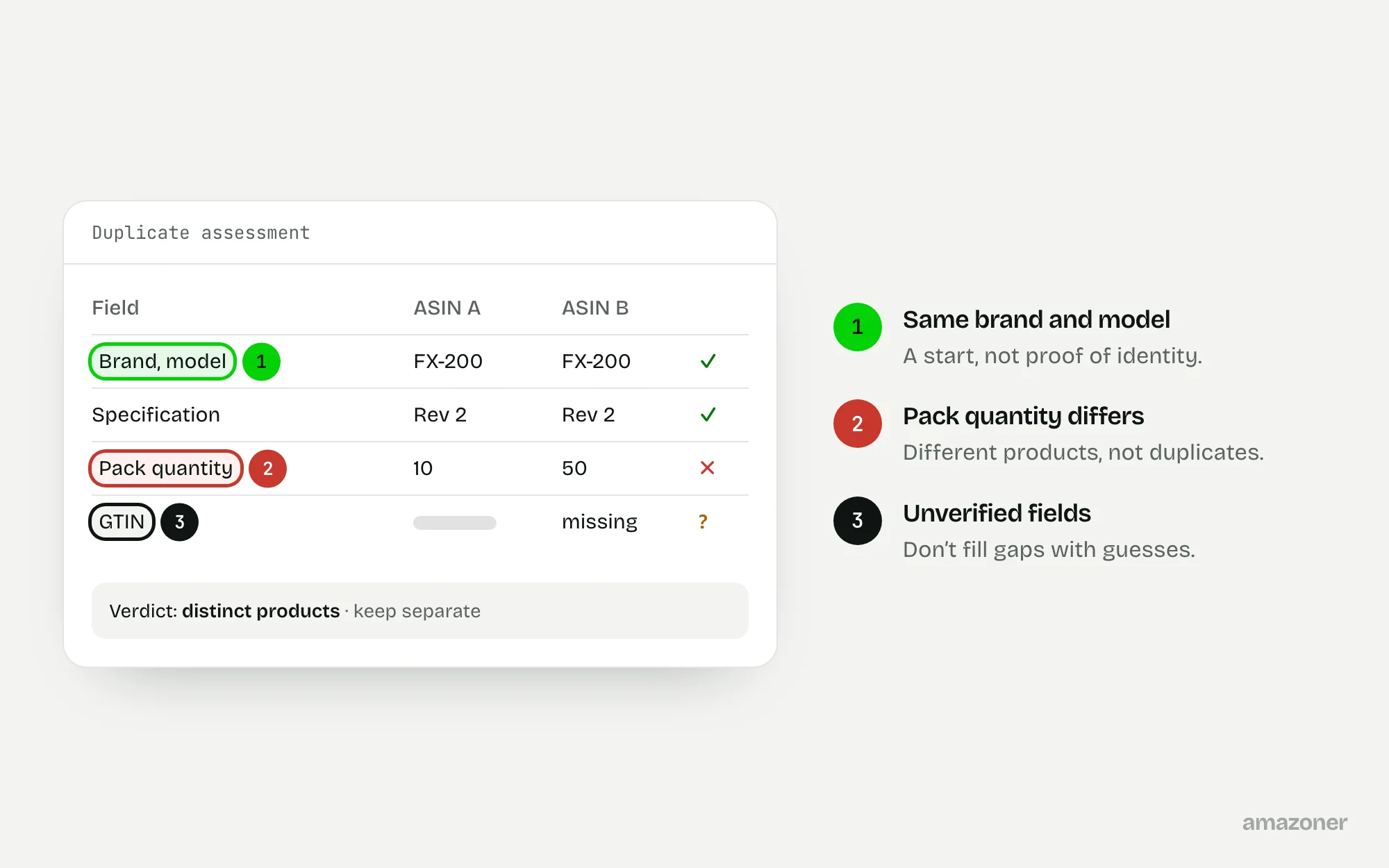
- A different quantity or bundle, which is a distinct product, not a duplicate.
A duplicate merge isn’t a variation change and shouldn’t combine related but different products. Matching photos or similar names don’t establish product identity.
Amazon decides whether a merge is appropriate and how records are handled. No retention of a preferred URL, content, review total or sales history should be promised.
Why it happens
Duplicates come from historical imports, different identifier submissions, incomplete product matching or catalogue migrations. Apparent duplicates can also be legitimate, when the model, specification or pack differs.
A sound decision starts from manufacturer evidence and a product-by-product identity check, not from which page has the most traffic or reviews.
How to diagnose it
- 1
List the candidates
Build a list from your catalogue export and any Potential Duplicates notice, with the notice’s response date and marketplace.
- 2
Gather manufacturer evidence
Collect identifiers, exact model, specification, pack quantity and label records for each candidate.
- 3
Compare side by side
Mark each field as matching, different or unverified. Don’t fill a missing identifier with a guess.
- 4
Map your operations
Map active SKUs, fulfilment identifiers, stock and open shipments to each ASIN before proposing changes.
- 5
Use the right workflow
For a genuine duplicate, prepare the evidence for Amazon’s review. For different products, dispute the match with the distinguishing facts.
- 6
Verify after any decision
Recheck product identity, content and SKU mappings against your baseline afterwards.
What we recommend
Classify candidate pairs as evidenced duplicates, distinct products or unresolved identity questions, and prepare a merge or incorrect-match evidence pack only after that.
Preserve original catalogue exports and operational mappings, and get seller approval before any change request. Don’t use merges to transfer unrelated history, bypass a restriction or turn a different product into an established ASIN.
Common mistakes
- Merging by image or keyword similarity without proving the product is the same.
- Combining different pack quantities or model revisions as duplicates.
- Choosing the retained ASIN for its reviews and promising all history will transfer.
- Changing identifiers before preserving evidence and mappings.
Prevention checklist
- Search the catalogue for the exact product before creating a new one.
- Keep a manufacturer-backed master of identifiers, models and packs.
- Respond to duplicate notices using the deadline shown in the account.
- Preserve catalogue exports and SKU mappings before structural changes.
- Verify product identity after any approved change.
What an audit gives you
Candidate pages classified as genuine duplicates, distinct pack configurations or open identity questions, with an evidence-based change brief.
Related questions
Are two identical-looking listings always duplicates?
No. Check manufacturer evidence, identifiers, model and pack. Similar photos can hide different products.
Can I merge different pack sizes?
Not as duplicates. Different pack configurations are distinct products under the catalogue rules.
Will a merge keep all reviews and history?
That can’t be guaranteed. A merge decides catalogue identity, not which metrics survive.
What if Amazon flags two different products as duplicates?
Keep the notice and submit the manufacturer evidence that distinguishes them through the current resolution route.
Sources
The seller questions and Amazon or regulator guidance this guide is based on, checked 7 November 2026.
- Trouble with duplicate ASINs? (Amazon seller forums)
- Duplicate ASIN Numbers / Items (Amazon seller forums)
- Merge Duplicate Product - Is the tool broken? (Amazon seller forums)
General guidance, not legal, tax or account-specific advice. Amazon’s rules, menus and programmes change; check the current version in your own account before acting.