
Why are my Amazon FBA fees too high after a dimension change?
Short answer
Compare the actual charged fee with the applicable marketplace fee schedule and the packaged unit’s recorded dimensions, weight and size tier. A fee estimate alone does not prove overcharging. If the evidence indicates incorrect measurements, use Amazon’s remeasurement process and separately assess any historical fee claim under the current eligibility rules.
Facts checked 3 min read
Also asked as
- How do I request an FBA remeasurement?
- Does Amazon use product or packaged dimensions for FBA fees?
- Will a corrected measurement refund old FBA charges?
A typical case
A flat-pack desk-accessory brand
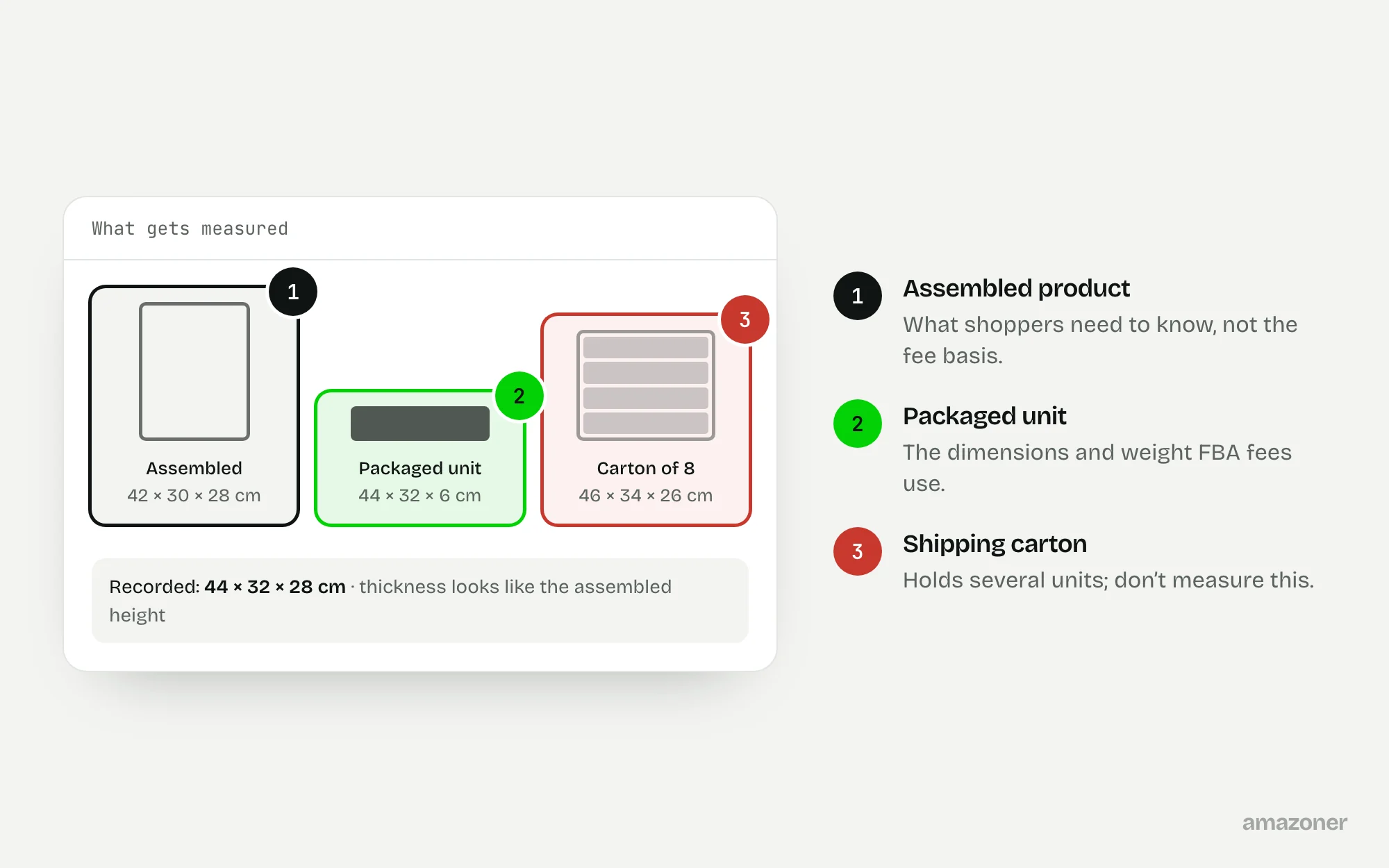
The products ship flat for customer assembly. Finance notices that the recorded package thickness and fee estimate have changed, while the product page shows assembled dimensions. The team assumes the assembled size is the charging basis and wants to delete the ASIN.
Don’t confuse these
- Product dimensions
- The size of the product itself, such as when assembled, which shoppers need to know.
- Packaged unit
- The unit as sold and shipped to the customer. FBA fees use its dimensions and weight.
- Shipping carton
- The outer box holding several units on the way to Amazon. It isn’t the fee basis.
FBA fees can depend on packaged dimensions, weight, category, programme and the rate schedule in force for the marketplace and date. A difference near a size-tier boundary may matter, but a fee increase can also be legitimate.
A successful measurement correction doesn’t automatically entitle you to every historical charge, or guarantee the next measured unit will match.
Why it happens
Catalogue data can confuse assembled size with the sellable package, and packaging can change between batches. Flexible bags, flaps and inconsistent packing change the measured size.
Weight or category can drive a fee even when dimensions look stable, and a calculator estimate can differ from the later charge because it uses different assumptions.
How to diagnose it
- 1
Identify exactly what’s assessed
Record the ASIN, SKU, FNSKU, marketplace and packaging version, with the current fee preview and its date.
- 2
Measure a real packaged unit
Measure a representative unit as sent to FBA, following Amazon’s guidance. Photograph the readings, without compressing the package.
- 3
Separate the measurements
Keep product dimensions, package dimensions and shipping weight apart, and note any mixed packaging batches.
- 4
Compare with the fee schedule
Check the recorded size tier against the current schedule for the marketplace. Use the Revenue Calculator to compare, not as proof.
- 5
Reconcile real charges
Match actual fulfilment-fee transactions on comparable orders, separating referral, storage and other fees.
- 6
Request remeasurement if justified
Raise it through the current workflow with the evidence, and assess any historical claim separately under current rules.
What we recommend
Prepare a measurement evidence pack and a transaction-level fee comparison, separating estimated discrepancies from verified charges. Recommend a remeasurement where the evidence supports it, and calculate any historical claim only within the applicable rules.
If packaging genuinely causes a higher tier, review compliant packaging alternatives with the supplier without compromising protection, identification or safety. Don’t delete or recreate an ASIN to get around the fee.
Common mistakes
- Measuring the assembled product or outer carton instead of the packaged unit.
- Treating a Revenue Calculator result as an invoice.
- Ignoring weight, category, packaging batches or surcharges.
- Promising a permanent reduction or unlimited refunds after a remeasurement.
Prevention checklist
- Keep an approved packaged-unit specification for every product and pack.
- Check the fee-tier impact before changing packaging.
- Compare fee previews with real charges after any packaging or rate change.
- Keep dated measurement evidence and support case references.
- Check eligibility per transaction for any historical fee dispute.
What an audit gives you
Packaged-unit measurements reconciled with actual fee transactions, a remeasurement request brief where the evidence supports one, and a separate review of historical charges.
Related questions
Do assembled dimensions set the FBA fee?
Not necessarily. Amazon says relevant FBA fees use the item’s package weight and dimensions. Check the actual charge basis.
Is a high fee estimate proof I’ve been overcharged?
No. Find an actual charged transaction and compare like for like before concluding anything.
Will remeasurement always lower the fee?
No. It may confirm or change the measurements, and other charging factors may still apply.
Are old overcharges refunded automatically?
Don’t assume so. Correcting a measurement and reimbursing past fees are separate checks with their own rules.
Sources
The seller questions and Amazon or regulator guidance this guide is based on, checked 7 November 2026.
- Incorrect Dimensions Causing Higher FBA Fees (Amazon seller forums)
- New listing extremely high estimated FBA fees (Amazon seller forums)
- FBA fees overcharged since Oct 2024 (Amazon seller forums)
General guidance, not legal, tax or account-specific advice. Amazon’s rules, menus and programmes change; check the current version in your own account before acting.