
How do I check whether Amazon owes an FBA inventory reimbursement?
Short answer
Reconcile the inventory event with later found-stock adjustments, replacements and reimbursements before treating it as an unpaid loss. Identify the claim type and current filing window, then gather the required ownership and transaction evidence. Valuation can depend on whether loss occurred before or after a customer order; retail selling price is not a universal entitlement.
Facts checked 3 min read
Also asked as
- How do I reconcile lost or damaged FBA stock?
- Why is my FBA reimbursement below the selling price?
- Which records support an inventory reimbursement claim?
A typical case
An FBA stationery brand
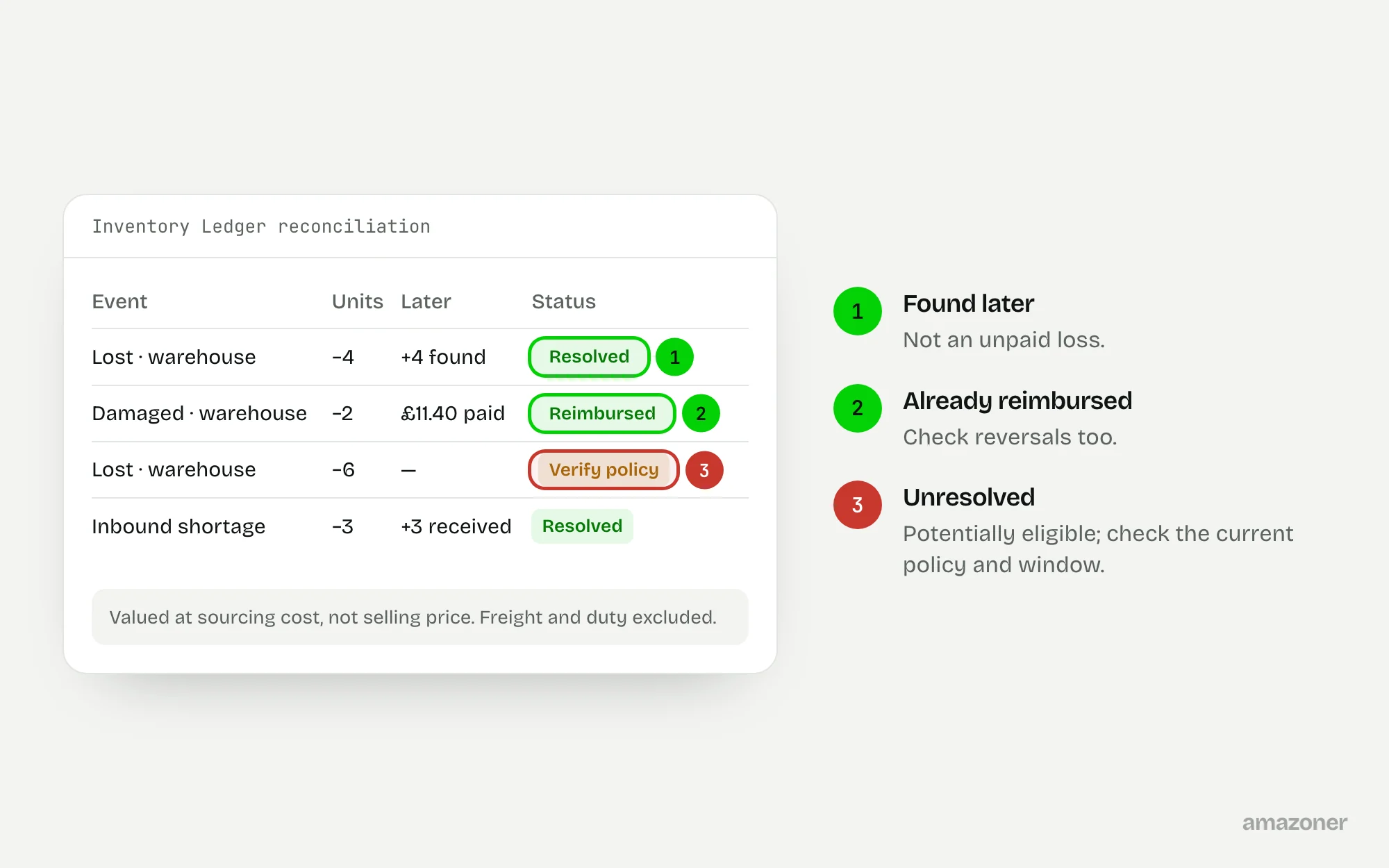
The finance team sees warehouse-loss and damage entries but can’t tell which are already resolved. Its spreadsheet counts every negative adjustment as a recoverable loss at the public selling price, without matching later found stock, reversals or sourcing-cost evidence.
Don’t confuse these
- Negative ledger event
- A recorded reduction in stock, such as lost or damaged in a warehouse.
- Found-stock adjustment
- A later positive entry when the missing units turn up.
- Reimbursement
- Payment or replacement units Amazon issues for an eligible loss, which can be reversed if stock is found.
A negative ledger movement isn’t automatically a compensable loss: stock may later be found, replaced, reimbursed or adjusted. Eligibility and claim windows differ by event type, and the event date may not be when the window starts.
Amazon distinguishes losses before and after a customer order. For relevant pre-order losses, sourcing cost excludes shipping, handling and customs duties. Use the current policy, not the retail price or an old universal deadline.
Why it happens
Inventory and payment records describe different stages of the same event and don’t always appear at the same time. An export can look like an unpaid shortage until it’s matched with a later reimbursement or found-stock entry.
Finance may use landed cost while the policy defines a narrower sourcing cost, and changing identifiers, bundles and incomplete purchase records make matching harder.
How to diagnose it
- 1
Export the Inventory Ledger
Keep SKU, FNSKU, event IDs, dates, quantities, disposition and reason codes. Don’t net unrelated items together.
- 2
Match losses with later entries
Pair negative events with later found stock and replacements, extending the period where needed.
- 3
Reconcile with reimbursements
Check the Reimbursements report, payment detail and the reimbursement portal where available, including reversals.
- 4
Classify what’s left
Sort remaining events by type, such as warehouse, inbound, return or removal, and read that type’s current eligibility and filing window.
- 5
Check sourcing cost
Review Manage Your Sourcing Cost where offered, and separate purchase cost from excluded freight and duty.
- 6
Prepare evidence for the rest
Build a claim-ready pack only for unresolved, potentially eligible events, for the seller to approve and submit.
What we recommend
Create an event-level exceptions ledger and a deadline register by policy; prioritise evidence gaps and imminent filing windows; reconcile already-resolved events before considering a new claim.
Prepare accurate sourcing-cost documentation and a concise evidence pack for seller review. Treat any reimbursement as contingent until approved and paid, and include later adjustments and reversals in the ongoing reconciliation.
Common mistakes
- Claiming every negative event without checking for found stock or payments already made.
- Using retail price or full landed cost as the value for every loss.
- Relying on an old forum deadline, or filing before an event is eligible.
- Altering purchase evidence, overstating quantities or duplicating claims.
Prevention checklist
- Reconcile inventory events with reimbursements and reversals on a fixed cycle.
- Keep product-level sourcing evidence and pack conversions organised.
- Record the policy, event type and filing window for each exception.
- Assign owners for investigation, approval and payment reconciliation.
- Report estimated recoveries separately from approved ones.
What an audit gives you
An exceptions register that separates unresolved events from stock already reimbursed or found, with evidence gaps and the applicable claim windows logged.
Related questions
Does Amazon always reimburse the selling price?
No. The basis depends on the policy and the event. Relevant pre-order losses can be valued at sourcing cost.
Can I include freight and duty in sourcing cost?
Amazon’s explanation excludes shipping, handling and customs duties from sourcing cost for the relevant calculation. Keep them for your profit analysis instead.
Is there one deadline for all reimbursement claims?
No. Warehouse, return, removal and inbound events can have different conditions and windows. Check the current rule for each event.
What happens if lost stock is found later?
The ledger and reimbursement can be adjusted, including a reversal. Check later entries before treating a loss as outstanding.
Sources
The seller questions and Amazon or regulator guidance this guide is based on, checked 7 November 2026.
- Update on eligibility window to file reimbursement claims (Amazon seller forums)
- FBA Inventory Reimbursement (Amazon seller forums)
- Make sure Amazon’s estimated sourcing costs are accurate (r/FulfillmentByAmazon)
General guidance, not legal, tax or account-specific advice. Amazon’s rules, menus and programmes change; check the current version in your own account before acting.