
What should I do if another seller joins my Amazon listing?
Short answer
Another seller on an Amazon detail page is not automatically a hijacker or counterfeiter. Check whether the offer matches the exact authentic product and whether catalogue content has changed. Preserve evidence of any mismatch or suspected infringement and use the appropriate Amazon reporting route. Brand Registry does not guarantee exclusive selling rights.
Facts checked 3 min read
Also asked as
- How do I report suspected Amazon listing hijacking?
- Can Brand Registry remove every other seller?
- Is another seller on my ASIN proof of counterfeiting?
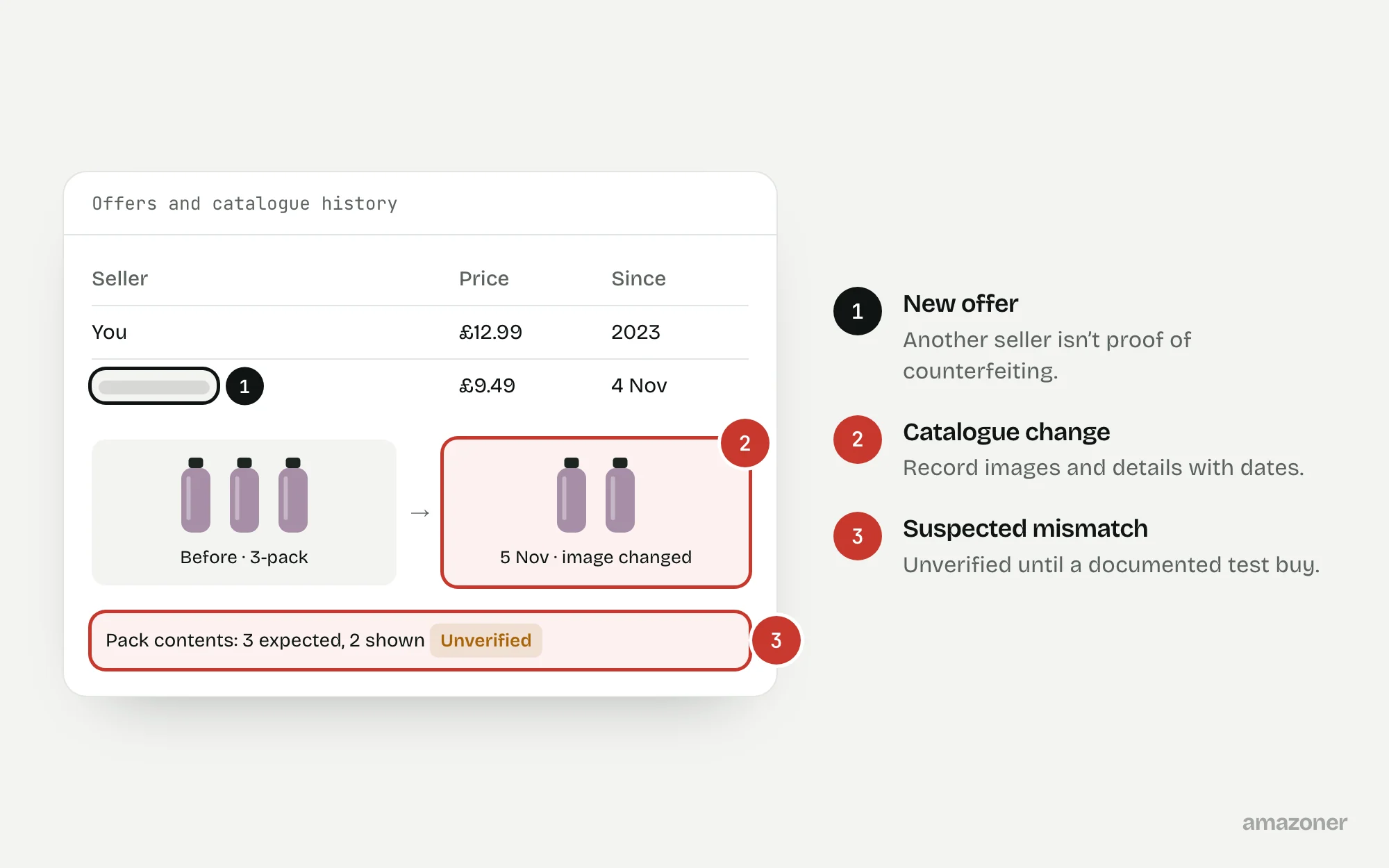
A typical case
A personal-care accessory brand
Unfamiliar offers appear on an established ASIN and the brand suspects counterfeits. A product-image change and a possible pack-content mismatch are visible, but public information can’t establish whether the other seller’s stock is authentic. That calls for evidence gathering, not a blanket removal request.
Don’t confuse these
- Authentic reseller
- Another seller offering genuine, matching stock, which Amazon generally allows.
- Catalogue change
- Someone altering images or details on the page, which may need a catalogue correction.
- Counterfeit
- Fake goods that infringe intellectual property, which have their own reporting route.
Reselling an authentic matching product, altering catalogue content and selling a counterfeit are different issues.
A lower price, an unfamiliar seller name or the absence of a direct brand contract isn’t proof of infringement on its own. Legal rights, approval requirements and the right reporting route depend on the facts.
Why it happens
Amazon lets more than one seller offer the same product on a single detail page, and resellers of genuine stock are allowed to join. Sellers can also contribute catalogue data, which can change images or details.
Counterfeit or mismatched products are a different problem with different reporting routes. The difficulty is that all three can look the same from the product page.
How to diagnose it
- 1
Capture evidence with dates
Record the offers, images, pack contents and any catalogue changes, with the date and marketplace of each observation.
- 2
Verify your rights
Check your brand rights and product identifiers, such as trademark registration and GTINs.
- 3
Separate the problems
Distinguish catalogue corrections that aren’t about intellectual property from suspected infringement.
- 4
Test buy if needed
If physical verification is warranted, arrange and document a lawful test purchase.
- 5
Use the right route
Prepare accurate evidence for Report Abuse, Brand Registry or the applicable infringement process.
- 6
Take advice where rights are disputed
Seek legal advice before making claims where the facts or rights aren’t clear.
What we recommend
Capture the relevant offer, product and catalogue differences with dates; verify the brand’s rights and the product identifiers; distinguish non-IP catalogue corrections from suspected IP infringement.
If physical verification is warranted, have the seller arrange and document a lawful test purchase. Prepare accurate evidence for Report Abuse, Brand Registry or the applicable infringement process; seek legal advice where rights are disputed and avoid unsupported complaints.
Common mistakes
- Treating every new seller on the listing as a hijacker.
- Filing infringement complaints without evidence.
- Expecting Brand Registry to remove all other sellers.
- Messaging other sellers with accusations you can’t support.
Prevention checklist
- Monitor new offers and catalogue changes on key ASINs.
- Keep brand rights documents and pack specifications to hand.
- Have a documented test-buy procedure ready.
- Use Brand Registry tools to protect your catalogue contributions.
- Record the date and marketplace of every observation.
What an audit gives you
A dated record of catalogue changes and offer differences, with a suspected-mismatch report prepared for the rights owner to review before any complaint is filed.
Related questions
Is another seller on my listing a hijacker?
Not automatically. Resellers of genuine stock can usually join the same detail page. Check whether the product matches and whether the page content has changed.
Can Brand Registry remove other sellers?
No. Brand Registry gives tools to protect your brand and content, but it doesn’t grant exclusive selling rights.
What evidence do I need to report a counterfeit?
Dated evidence of the difference, your rights in the brand, and usually a documented test purchase. Use the reporting route that matches the issue.
Sources
The seller questions and Amazon or regulator guidance this guide is based on, checked 7 November 2026.
- Please help!! Listing hijacked (Amazon seller forums)
- ASIN buy box got hijacked (Amazon seller forums)
- Amazon Brand Registry FAQ (Amazon UK)
General guidance, not legal, tax or account-specific advice. Amazon’s rules, menus and programmes change; check the current version in your own account before acting.