
How do I reduce Amazon ACOS when clicks are not converting?
Short answer
High Amazon ACOS can reflect expensive traffic, weak conversion, low order value or a combination. Calculate ad spend against attributed sales, then compare the result with your pre-advertising contribution margin on a consistent revenue basis. Review search-term relevance, offers and listing clarity before increasing spend; a listing audit does not replace campaign analysis.
Facts checked 3 min read
Also asked as
- Why is my Amazon ACOS so high?
- Why do my Amazon ads get clicks but no sales?
- Can a listing audit improve conversion before more ad spend?
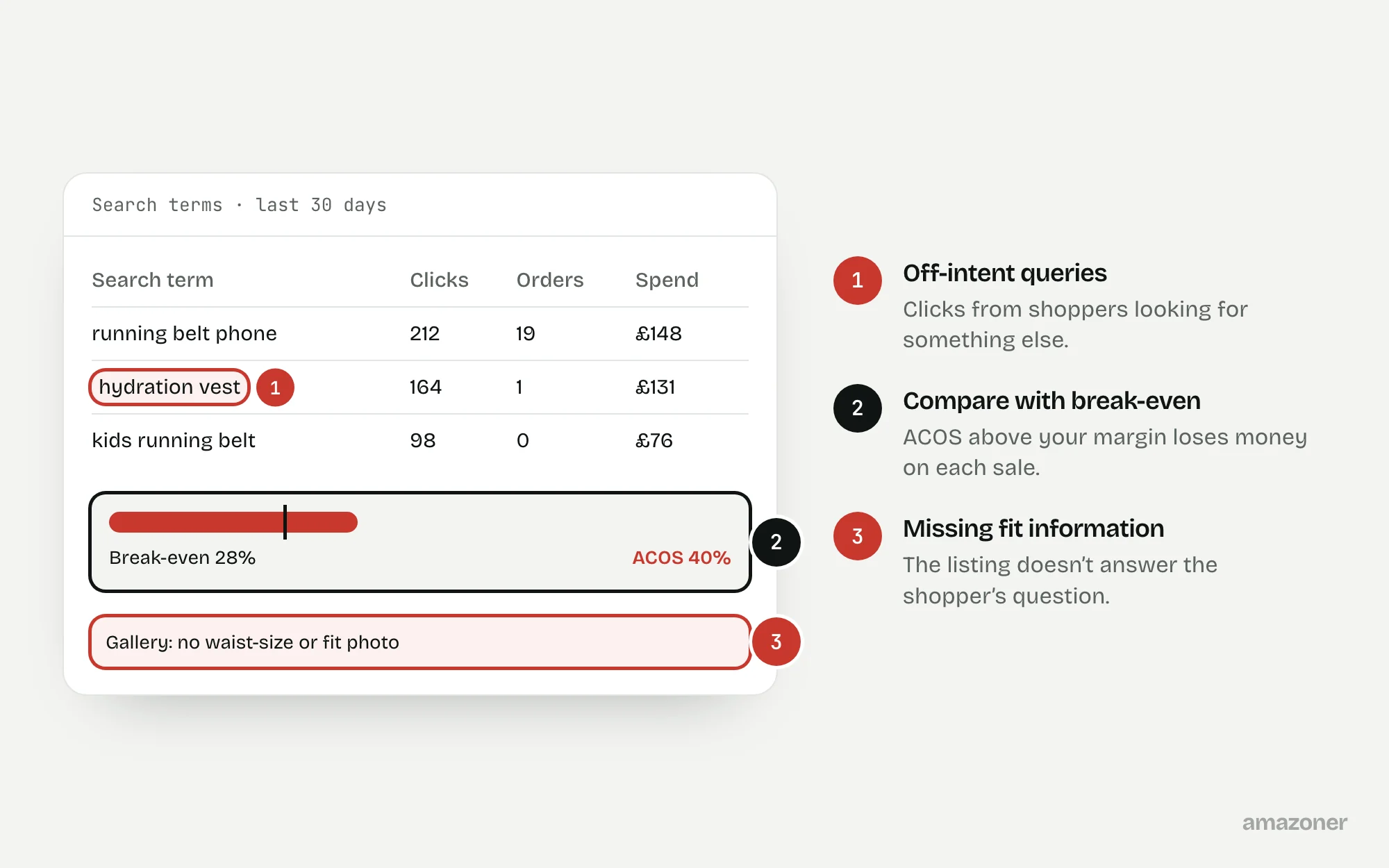
A typical case
A sports-accessory brand
Broad queries attract shoppers looking for a different use, and the gallery doesn’t explain the product’s fit limits. The result is a traffic mismatch and a purchase-information gap at the same time, and the ACOS reflects both.
Don’t confuse these
- ACOS
- Ad spend divided by ad-attributed sales, as a percentage.
- TACOS
- Ad spend divided by total sales, including organic, as a percentage.
- Break-even ACOS
- Your contribution margin before advertising. Above it, attributed sales lose money on the ads.
ACOS is ad spend divided by ad-attributed sales. It isn’t total profit, or total advertising cost against all revenue. Reporting windows and attribution matter.
Compare ACOS with a contribution margin calculated on the same revenue basis, with consistent VAT treatment.
Why it happens
ACOS rises when clicks cost more, when fewer clicks turn into orders, or when each order is worth less. Broad match and automatic targeting can bring in shoppers looking for something else.
A listing that doesn’t answer key questions such as fit, size or compatibility loses buyers who did click. So high ACOS is often part traffic problem and part listing problem.
How to diagnose it
- 1
Reconcile spend and sales
Use comparable, completed reporting periods and note the attribution window.
- 2
Calculate contribution margin
Work out each product’s margin after fees, returns and costs, with consistent VAT treatment.
- 3
Review search terms
Find queries whose intent doesn’t match the product and flag them with the campaign owner.
- 4
Check the landing listing
Make sure the listing answers the questions behind the queries that do convert, such as fit and use.
- 5
Check the offer
Compare price, delivery and Featured Offer status with competing offers.
- 6
Test changes separately
Where possible, test listing changes on their own so their effect can be seen.
Worked example
| Ad spend in the period | £600 |
|---|---|
| Ad-attributed sales | £1,500 |
| ACOS (£600 ÷ £1,500) | 40% |
| Contribution margin before ads, same revenue basis | 28% |
At 40% ACOS against a 28% margin, each attributed sale loses about 12% of its revenue on advertising. 28% is this product’s break-even point, not a universal target.
What we recommend
Reconcile ad spend and attributed sales over comparable completed reporting periods; calculate product-level contribution after relevant fees, returns and costs with consistent VAT treatment; review query relevance and campaign settings with the campaign owner.
Correct unclear fit and use-case information, inspect offer competitiveness and test eligible listing changes separately where possible. Judge profitability and sales together rather than chasing a lower ACOS alone.
Common mistakes
- Cutting bids across the board instead of fixing irrelevant traffic.
- Comparing ACOS with a margin that includes VAT inconsistently.
- Judging campaigns before the attribution window has closed.
- Chasing a low ACOS at the cost of sales and total profit.
Prevention checklist
- Know each product’s break-even ACOS.
- Review search terms on a regular cycle.
- Add negative terms for clearly irrelevant intent.
- Keep fit and use information prominent in the listing.
- Report ACOS alongside attributed sales and contribution.
What an audit gives you
Search-term exclusions and a fit-information brief for the listing, with attributed sales, ACOS and contribution tracked together at the next review.
Related questions
What is a good ACOS?
There’s no universal figure. Compare ACOS with your break-even point, which is the product’s contribution margin before advertising.
Why do my ads get clicks but no sales?
Usually because the queries don’t match what the product is, or the listing doesn’t answer the shopper’s questions. Check both search terms and the listing.
Can a listing audit replace PPC management?
No. It improves the page the ads send shoppers to. Campaign structure, bids and targeting still need their own analysis.
Sources
The seller questions and Amazon or regulator guidance this guide is based on, checked 7 November 2026.
- Can we have a discussion on what everyone does to lower ACOS? (r/AmazonSeller)
- How to optimise Amazon’s sponsored ads? (r/AmazonSeller)
- What is advertising cost of sales (ACOS)? (Amazon Ads)
General guidance, not legal, tax or account-specific advice. Amazon’s rules, menus and programmes change; check the current version in your own account before acting.